




Long-lasting solution: Radiation-crosslinked PE-Xc pipes for drinking water supply
Drinking water supply systems place high demands on piping. This applies both to the refurbishment of urban networks and to new residential developments or installations in hospitals, care homes, hotels, sports facilities and schools. PE-Xc is also relevant in cruise ship construction as a component of multilayer composite pipes, where drinking water hygiene, neutral taste, dimensional stability, pressure and temperature resistance, and marine certification are all essential requirements. Electron-beam-crosslinked polyethylene is replacing conventional pipe materials and has proven effective wherever large volumes of oxygen-rich fresh water circulate and are regularly drawn off. Radiation-crosslinked PE-Xc pipes and rods exhibit high resistance to pressure, temperature and mechanical stress. This makes them suitable for applications that must remain stable over long periods and meet stringent hygiene requirements.
Improving the properties of plastic pipes through radiation crosslinking
|
|
|
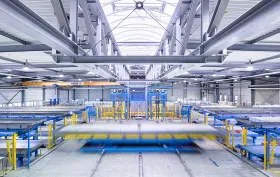
Multilayer composite pipes, wound onto reels or supplied as straight lengths, can be crosslinked in a single processing step. (Copyright: BGS/Markus Steur) |

PE-Xc-based piping systems for transporting drinking water offer significant advantages over conventional materials such as cast iron, PVC and steel. High-energy ionizing electron radiation can be used to specifically enhance pipes, fittings and couplings: the resulting crosslinked structure significantly improves temperature resistance and resistance to stress cracking. These properties make a major contribution to operational reliability and longevity under demanding conditions. Particularly important are improved long-term hydrostatic strength at elevated temperatures and internal pressures, as well as enhanced dimensional stability.
Electron beams generated by accelerators, typically with energies of up to 10 megaelectronvolts (MeV), are used for irradiation. During crosslinking, the pipe passes through an electron beam. The beam energy triggers targeted chemical reactions within the plastic: individual polymer chains bond together to form a three-dimensional network. The resulting uniformly crosslinked pipe is designated PE-Xc. The “X” stands for crosslinking, while the “c” identifies the physical radiation-crosslinking method. The result is a lasting improvement in heat resistance, chemical resistance, creep behavior and abrasion resistance. The enhanced pipe can therefore be used under more demanding conditions with a significantly longer service life. Radiation crosslinking is a precisely controllable process: the radiation dose can be used to achieve and reliably reproduce the desired material properties. Irradiation is the final processing step before the products are delivered.
Material property improvements in detail
HDPE pipes have been radiation-crosslinked for decades to ensure their performance characteristics. For drinking water transport pipelines, temperature and pressure resistance are not the only important factors. Weight, corrosion resistance, installation effort, sound insulation and water hygiene also play an important role, particularly in shipbuilding and hotels. Radiation crosslinking and the resulting material properties provide PE-Xc pipes with several application-specific advantages:
- Significantly lower weight than metal piping systems, making transport, handling and installation easier.
- A corrosion-free material base that makes PE-Xc pipes less susceptible to rust-related deposits or material damage.
- Fast and flexible installation, as plastic pipes are easy to process and adapt to structural conditions, for example in renovation projects or complex piping layouts in hotels.
- Vibration- and sound-damping properties that can help reduce vibrations and operating noise in ships and hotels.
- Good suitability for hygiene-sensitive drinking water applications, provided the pipes have the appropriate certification. The corrosion-free surface prevents particles caused by corrosion from entering the drinking water.
Radiation crosslinking of PE-Xc pipes and rods
Radiation crosslinking is carried out continuously after extrusion using high-energy electrons. Crosslinking prevents the steep decline in performance typically observed in long-term internal pressure testing of thermoplastic pipes, particularly at high temperatures of up to 95 °C. It also makes the pipe less susceptible to stress cracking and the effects of chemicals or aggressive media.
Multilayer composite pipes, wound onto reels or supplied as straight lengths, can also be crosslinked in a single processing step. The electron beam can readily penetrate the thin metal liner. This also improves the bond strength, or coupling, between the metal liner and the pipe’s plastic material at the interface. Unlike chemically crosslinked PE-Xa and PE-Xb pipes, radiation-crosslinked PE-Xc pipes carry no risk of residues from crosslinking chemicals. Compared with chemical crosslinking methods, the physical radiation-crosslinking process also offers very high process reliability and significantly higher production speeds.
Radiation-crosslinked PE-Xc pipes in the logistics chain
For PE-Xc pipes, radiation crosslinking is performed as the final step after shaping, on the way to the end customer. One advantage of treatment with ionizing radiation is that, following a straightforward release step, products can be used or processed immediately, without further testing, storage or waiting times.
|
|
|
Radiation-crosslinked PE-Xc pipes retain their stability even at high temperatures and under long-term pressure loads – unlike non-crosslinked polyethylene, which fails prematurely. |

Irradiation is generally performed by specialized service providers because building and operating the necessary facilities is complex. Operators of electron accelerators must, among other things, comply with stringent structural safety standards and provide extensive monitoring technology. External service providers offer a clear advantage, particularly in series production. Thanks to their capacity utilization and expertise, their processes are highly automated, ensuring the necessary speed and high quality standards.
PE-Xc pipes pass through the irradiation unit in just a few seconds. A standardized test method is then used to verify that the required degree of crosslinking has been achieved. The product is subsequently ready for immediate use. Ideally, the service provider ensures full traceability by recording every order from goods receipt through irradiation to delivery and documenting it in accordance with regulatory requirements.
Dr. Michal Daněk
BGS Beta-Gamma-Service GmbH & Co. KG
Tel: +420 518 324 510
Email: danek@bgs.eu
https://bgs.eu/en/radiation-crosslinking/
-

BGS Beta-Gamma-Service GmbH & Co. KG.
Industrielle Bestrahlung, Verfahren zur Optimierung von Kunststoffprodukten, Strahlenvernetzung von Kunststoffprodukten, Strahlensterilisation…
Lieferanten zu diesem Thema
-

UPT, s.r.o.
Kläranlagen, Fettabscheider, Kunststoffschächte, Kunststoffbehälter für Häuser und Bauwerke, Behälter für die… -

FMP a.s.
Spritzgießen von Kunststoffen, Kunststoffpressen, Werkzeugbau, Konstruktion und Fertigung von Werkzeugen… -

Simona Plast-Technik s.r.o.
SIMONA thermoplastische Halbzeuge, Kunststoffarmaturen, Kunststoffrohre, Rohrleitungen, Schläuche, Rohre… -

TOMIRTECH, s.r.o.
Technische Kunststoffteile, Kunststoffformteile, Gummidichtungen, Kunststoffrohre, Rohrleitungen, Schläuche, Röhren… -

Plastika, a.s. Nitra
Kunststoffverarbeiter und Lieferant von Kunststoffprodukten, Kunststoffrohre, Rohrleitungssysteme… -

PANAS Tools s.r.o.
Hartmetallfräser, Bohrer und Gewindebohrer für Werkzeugstähle, Diamantwerkzeuge, Messmittel, Spannmittel…




INOFEST 2026: Automobilwerk und Weinberg stehen vor denselben Herausforderungen. In Nitra wurde das deutlich
05.10.2026 Das Kreativzentrum der Slowakischen Landwirtschaftlichen Universität in Nitra war am 29. September Gastgeber der siebten Ausgabe des Innovationsfestivals INOFEST. Es kamen 164 Teilnehmer, 28 Referenten traten auf, 53 Unternehmen sowie 16...